

On this page
Yes, you can prepare for UPSC at home, and people clear it without coaching every year. What coaching sells is structure: a fixed schedule, a narrowed-down reading list, regular tests, and a room full of people doing the same thing. You can build all four yourself. This guide shows you how, step by step.
It will not promise you a rank. In CSE 2024, 5,83,213 candidates sat the Prelims and 1,009 were recommended for appointment, and no method guarantees a first-attempt result. What a good plan does is make sure you walk in having covered the syllabus, revised it several times, and practised under exam conditions. That is what first-attempt clearers have in common.
UPSC CSE 2024, stage by stage
- 9,92,599Applied
- 5,83,213Sat the Prelims58.8% of the previous stage
- 14,627Qualified for Mains2.5% of the previous stage
- 2,845Called for interview19.5% of the previous stage
- 1,009Recommended for appointment35.5% of the previous stage
About 1 in 578 candidates who sat the Prelims made the final list.
Can you really clear UPSC without coaching?
You can, if you replace what coaching provides. Here is what that looks like in practice.
| What coaching gives you | How to replace it at home |
|---|---|
| A fixed timetable | A written weekly plan with daily targets (Step 4 and Step 5) |
| A narrowed-down booklist | One standard source per subject (Step 3) |
| Regular tests | Previous year papers and a test series you take at home (Step 8) |
| Someone noticing when you skip a day | A tracking system and one accountability partner (Step 9) |
| Current affairs handouts | One newspaper and one monthly compilation (Step 6) |
The thing home preparation usually lacks is not information. Every book, lecture, and past paper is available to you. What it lacks is enforcement: nobody notices when you skip revision. Most of this guide is about building that enforcement yourself.
When other persons give you instructions on how to study, they may not have considered your strengths and weaknesses. At the same time, self-study boosts your confidence.
Step 1: Understand the exam before you study for it
The Civil Services Examination has three stages. Each one tests a different skill, so each needs a different kind of preparation.
| Stage | Format | Marks | What it tests |
|---|---|---|---|
| Prelims | Two objective papers: General Studies (100 questions) and CSAT | 200 each. CSAT is qualifying at 33%. One-third negative marking. | Breadth, accuracy, elimination |
| Mains | Nine descriptive papers: two qualifying language papers, Essay, four General Studies papers, two Optional papers | 1,750 counted for merit | Depth, structure, written expression |
| Interview | Personality test | 275 | Clarity of thought, judgment, composure |
Prelims marks only decide whether you reach Mains. Your final rank comes from Mains plus the Interview, out of 2,025 marks.
- Stage 1Prelims400 marks2 objective papers · qualifying only
- Stage 2Mains1,750 marks9 descriptive papers · counted for merit
- Stage 3Interview275 marksPersonality test · counted for merit
Final rank = Mains + Interview 2,025 marks
General category candidates get six attempts between the ages of 21 and 32, with more attempts and a higher age limit for reserved categories. Check the current notification on upsc.gov.in for the exact rules and dates for your cycle.
Step 2: Read the syllabus and past papers first
Before you open a single book, do two things.
- Print the official syllabus for Prelims and Mains and keep it on your desk. It is only a few pages long. Every topic you study should map to a line in it.
- Go through the last five years of question papers. You do not need to solve them yet. Read them to see what UPSC actually asks, how current affairs is mixed with static subjects, and how deep the questions go.
This takes two or three days, and it will save you months. Most wasted effort in UPSC preparation comes from studying things the exam never asks.
Step 3: Keep your booklist short
Aspirants preparing at home tend to collect material, because there is no teacher telling them what to ignore. Resist that. Pick one standard source per subject and read it several times, rather than reading five sources once.
For the same topic, do not refer to more than one material.
| Subject | Start with | Then |
|---|---|---|
| Polity | NCERT Class 11 (Indian Constitution at Work) | Indian Polity by M. Laxmikanth |
| Modern history | NCERT Class 12 themes | A Brief History of Modern India (Spectrum) |
| Ancient and medieval history | Old NCERTs or Tamil Nadu board textbooks | Previous year questions |
| Art and culture | NCERT Class 11 (An Introduction to Indian Art) | Indian Art and Culture by Nitin Singhania, selectively |
| Geography | NCERT Class 11 and 12 | Certificate Physical and Human Geography by G.C. Leong, plus an atlas |
| Economy | NCERT Class 11 and 12 | Economic Survey and Budget summaries |
| Environment | NCERT Biology (ecology chapters) | Environment by Shankar IAS |
| Science and technology | NCERT Class 6 to 10 | Current affairs |
| CSAT | Previous year papers | A practice book only if you score below the cut-off |
NCERTs come first in almost every row for a reason. They are short, they build the base that the standard books assume, and UPSC questions regularly trace back to them.
Step 4: Build a 12-month plan
A year is enough for a first attempt if you study consistently. Split it into four phases.
| Phase | Months | Focus |
|---|---|---|
| Foundation | 1 to 4 | NCERTs and standard books for all General Studies subjects. Start reading the newspaper from day one. Choose your optional by the end of month 2. |
| Depth | 5 to 8 | Finish the optional. Start Mains answer writing, a few answers a week. Second reading of the General Studies subjects. |
| Prelims focus | 9 to 11 | Mock tests, previous year papers, CSAT practice, and repeated revision. No new sources. |
| Final revision | 12 | Only your own notes, mock analysis, and current affairs compilations. |
- 01 · Months 1–4FoundationNCERTs, standard books, daily newspaper, choose your optional.
- 02 · Months 5–8DepthFinish the optional, start answer writing, second reading of GS.
- 03 · Months 9–11Prelims focusMocks, previous year papers, CSAT. No new sources.
- 04 · Month 12Final revisionYour own notes, mock analysis, current affairs compilations.
After Prelims, the gap before Mains is short, which is why answer writing starts in month 5 and not after the Prelims result.
Step 5: Set a daily routine you can keep
The best routine is the one you can repeat for a year. Two examples follow; adjust the times to your own day.
If you are preparing full-time (7 to 8 hours of study)
| Time | Activity |
|---|---|
| Morning, 3 hours | The hardest static subject of the day |
| Late morning, 1 hour | Newspaper and current affairs notes |
| Afternoon, 2 hours | Optional subject |
| Evening, 1.5 hours | Answer writing or MCQ practice |
| Night, 30 to 45 minutes | Revision of what you read today and what is due from earlier |
If you have a full-time job (3 to 4 hours on weekdays)
| Time | Activity |
|---|---|
| Early morning, 1.5 to 2 hours | Static subject, before work |
| Commute or lunch, 30 to 45 minutes | Current affairs |
| Night, 1 hour | Revision and a short quiz on the day's reading |
| Weekends, 7 to 8 hours a day | Optional, answer writing, mock tests |
Working professionals clear this exam regularly. They have fewer hours, so they cannot afford to waste any on re-reading things they have already forgotten. That makes the night revision slot the most important hour of the day.
Step 6: Handle daily current affairs in under an hour
Current affairs is where home preparation most often goes wrong, because there is no natural stopping point. Set a limit of 45 to 60 minutes a day and follow this routine.
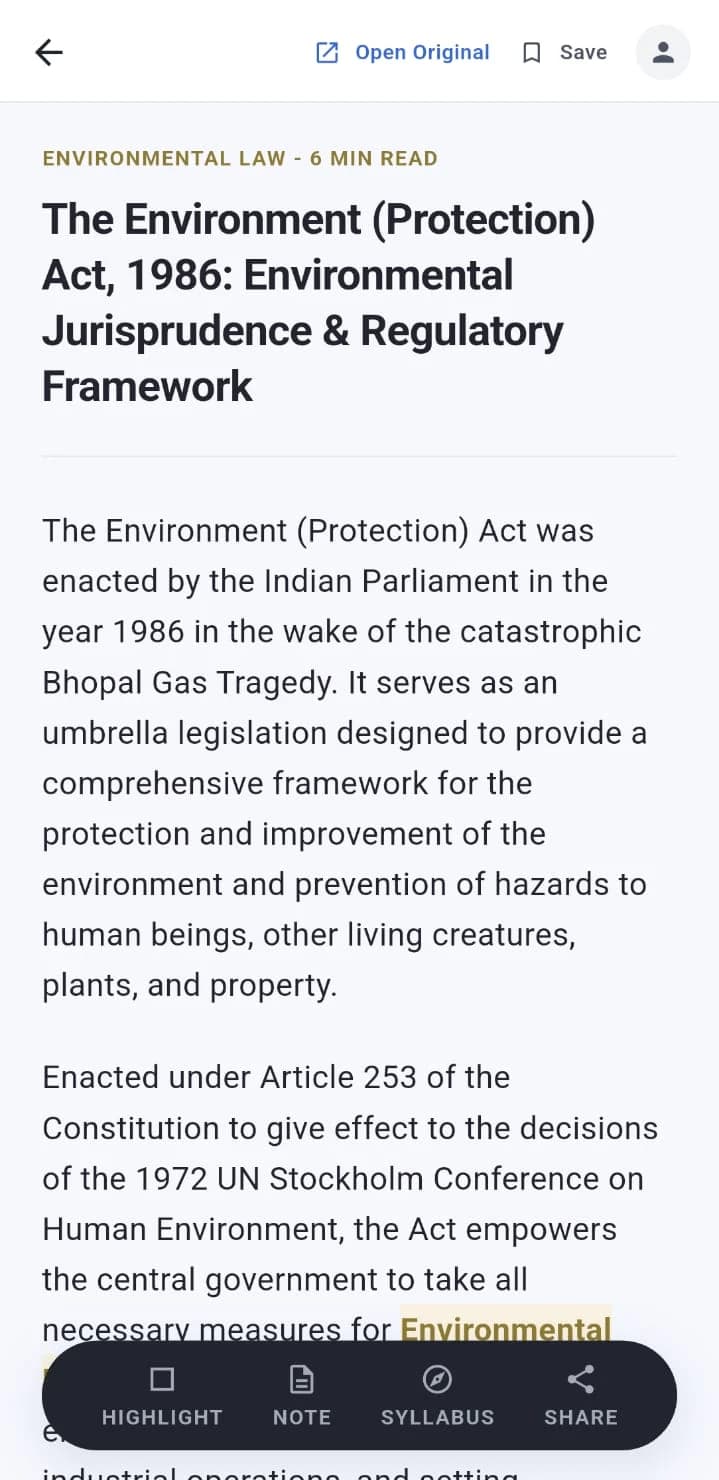
- Read one newspaper. The Hindu or The Indian Express. Not both.
- Read with the syllabus beside you. Keep an article only if it connects to a syllabus topic. Skip party politics, crime, sports results, and most of the business pages.
- Note the issue, not the news. For each article worth keeping, write two or three lines: what the issue is, why it matters, and which syllabus topic it belongs to.
- Use one monthly compilation to catch what you missed. Do not use it in place of the newspaper for the first few months, because reading the paper is how you learn to judge relevance.
- Quiz yourself the same day on what you read. News you only read once is gone within a week.
Reading a newspaper helps you learn about many matters and prompts you to explore deeper.
Step 7: Build a revision system
This is the step that separates people who clear from people who covered the same syllabus and did not.
You will read a chapter on fundamental rights in month 2. Without revision, most of it will be gone by month 4. That is how memory works: recall drops quickly after first exposure and flattens only when you revisit the material. Hermann Ebbinghaus first measured this forgetting curve in the 1880s, and it held up when researchers repeated his experiment in 2015. Two habits fix it.
Space your revisions. Revisit each topic at widening intervals instead of cramming it once. A simple schedule:
- The same night you read it
- 3 days later
- 7 days later
- 30 days later
- Then once in each later phase of your plan
The widening gaps are not guesswork. A review of 317 experiments on spaced practice found that the best gap between study sessions grows the longer you need to remember the material (Cepeda et al., 2006). UPSC asks you to remember for a year, so your gaps should keep growing.
Test yourself instead of re-reading. Re-reading feels productive because the page looks familiar, but familiarity is not recall. Close the book and try to answer questions from memory. Getting an answer wrong and then checking it does more for retention than reading the page a third time.
The difficulty is running this by hand. By month 6 you have hundreds of topics, each on its own revision schedule, and a notebook cannot tell you which twelve are due today. A coaching classroom forces revision through weekly tests. At home you need a tool to do that job.
Revision is the absolute key.
Step 8: Test yourself the way UPSC will
- Previous year questions. Solve at least the last ten years of Prelims papers, subject by subject as you finish each one. They show you the level of difficulty better than any mock. You can practise UPSC Prelims PYQs topic-wise for free, with the answer and the trap shown as you go.
- Prelims mocks. Take a full-length test every week in the Prelims phase, at the real exam time, on paper. Spend as long analysing each test as you spent taking it.
- Answer writing. From month 5, write two or three Mains answers a week within the time limit. Compare them with topper copies or model answers, which are freely available.
- Optional. Solve past optional papers. The optional carries 500 marks and is the paper home-prepared candidates most often under-practise.
A paid test series is the one thing worth buying even if you skip coaching, because it gives you a comparison against other aspirants.
Step 9: Stay consistent without a classroom
Inconsistency is the most common reason home preparation fails. It is rarely a motivation problem. It is usually a tracking problem: nobody, including you, can see that you have slipped.
- Track every day. Log what you read and whether you revised. A visible streak is harder to break than a private intention.
- Set targets by output, not hours. "Finish chapters 4 to 6 of Laxmikanth" is checkable. "Study polity for three hours" is not.
- Find one accountability partner. Share weekly targets with one other aspirant, online or offline. One is enough.
- Plan one half-day off a week. Rest you schedule keeps you going longer than rest you take when you collapse.
- Have a rule for bad days. On a day when nothing works, do only the night revision. It keeps the habit alive and costs 30 minutes.
Mistakes to avoid when preparing at home
- Collecting PDFs, notes, and channels instead of finishing one source
- Putting off answer writing until after Prelims
- Reading the newspaper for two hours and making notes on everything
- Treating CSAT as a formality, then missing the 33% cut-off
- Skipping revision to "cover more", then discovering in the mocks that nothing has stayed
- Choosing an optional because a topper chose it, not because you can live with it for a year
How Tootler helps you prepare at home
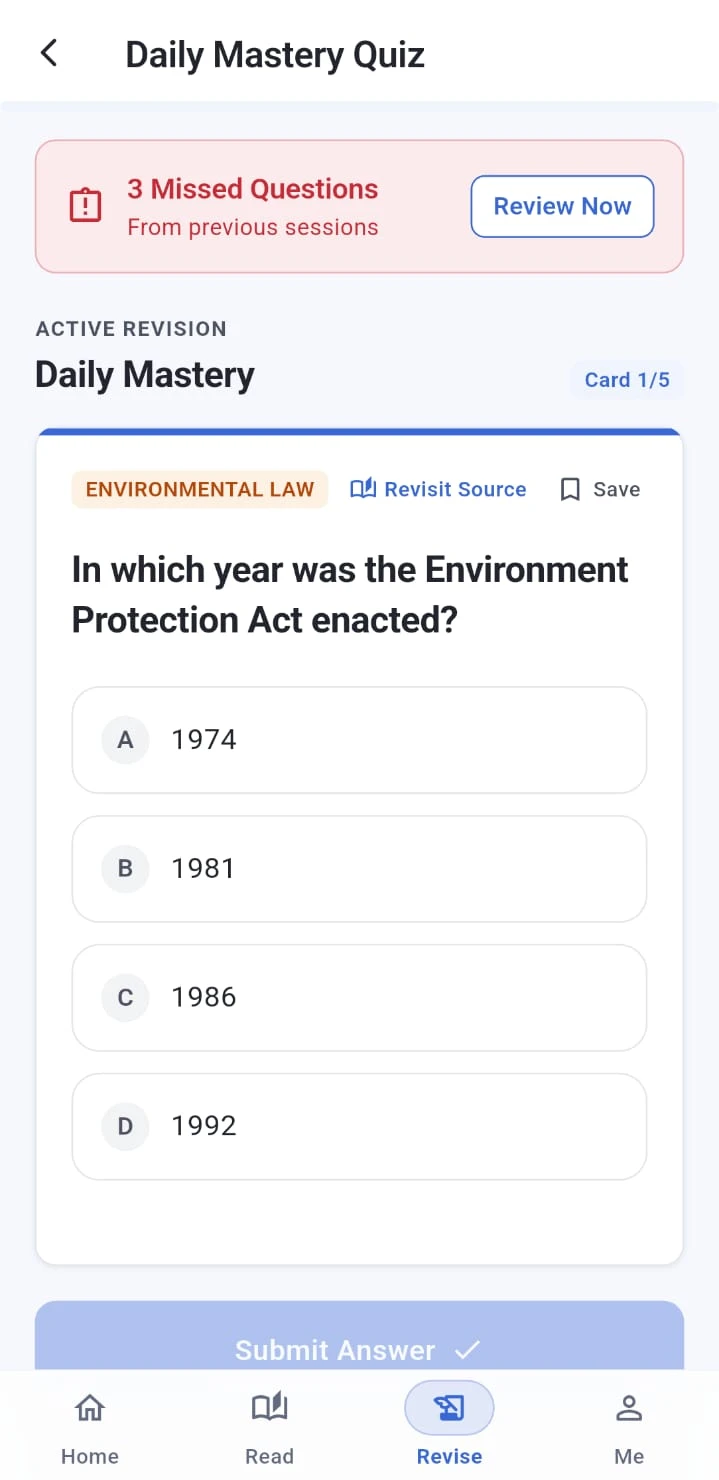
Tootler is built for the part of home preparation that books and videos do not solve: remembering what you read and coming back every day. It does three things.
- Tracks your daily reading, so you can see what you covered and whether you are keeping to your plan.
- Quizzes you every day on what you read, so your first revision happens while the reading is still fresh.
- Brings topics back through spaced revision, so you revise what is due without keeping the schedule yourself.
It is deliberately free of feeds, videos, and other distractions, and it keeps your reading and revision progress in one place so the routine holds on the days you would rather skip.
Tootler does not replace your books, your newspaper, or your test series. It makes sure the hours you spend on them are not lost.
Frequently asked questions
How can I prepare for the UPSC exam at home?
Start with the official syllabus and the last five years of question papers. Read the NCERTs, then one standard book per subject. Read one newspaper daily, revise on a spaced schedule, solve previous year papers, and take weekly mock tests in the months before Prelims. A written 12-month plan and a way of tracking your daily work replace the structure coaching would give you.
Can I clear IAS in my first attempt without coaching?
Yes, it is possible, and candidates do it every year. It needs about a year of consistent study, a limited booklist, several rounds of revision, and regular practice with mocks and answer writing. Coaching does not provide information you cannot get elsewhere. It provides discipline, which you will have to build yourself.
How many hours should I study for UPSC at home?
Full-time aspirants typically study 7 to 8 focused hours a day. Working professionals can manage with 3 to 4 hours on weekdays and 7 to 8 on weekends. Consistency over a year matters more than the daily number.
How do I cover daily current affairs for UPSC?
Read one newspaper for 45 to 60 minutes with the syllabus beside you, note only the issues that map to a syllabus topic, and use one monthly compilation to fill gaps. Revise your notes the same night and again at the end of the week.
Is one year enough to prepare for UPSC?
One year is enough for a serious first attempt if you start with the syllabus, keep your sources limited, and revise regularly. Many candidates take longer, usually because of gaps in revision or answer-writing practice and not because the syllabus cannot be covered in a year.
Which is the best app for UPSC preparation at home?
It depends on what you need. For lectures and test series, the large coaching platforms have apps. For remembering what you study and staying consistent, use a revision app built on spaced repetition and daily quizzes, such as Tootler.
The short version
Preparing for UPSC at home works when you supply your own structure. Know the exam, keep the booklist short, follow a 12-month plan, cap current affairs at an hour, and revise everything on a schedule. If you fix only one thing, fix revision, because it decides how much of your year of reading is still with you on exam day.
Sources
- UPSC CSE 2024 stage-wise numbers: UPSC results announcement, reported by DD India and IANS, 22 April 2025.
- Testing versus re-reading: Roediger, H. L. and Karpicke, J. D. (2006), Test-Enhanced Learning, Psychological Science. Summary by Washington University in St. Louis.
- Spacing: Cepeda, N. J. et al. (2006), Distributed practice in verbal recall tasks, Psychological Bulletin (PubMed).
- Forgetting curve: Murre, J. M. J. and Dros, J. (2015), Replication and Analysis of Ebbinghaus' Forgetting Curve, PLOS ONE.
- Quotes: Gahana Navya James in Onmanorama (24 May 2023); Anudeep Durishetty on his blog. Quoted as published. Neither is affiliated with or endorses Tootler.